
Technology is a part of how businesses work today. Companies use technology to manage customer information and help employees work together from locations. However as technology gets more complicated businesses face technical problems. This is where IT Support comes in.
IT Support is not about fixing computers when they break. Today IT professionals help companies keep their technology running safely. This can be done by a team within the company or by a Managed Service Provider. Having IT Support can really reduce downtime and make businesses more productive.
What is IT Support?
IT Support and IT support company is a range of services that help businesses manage and fix their technology. These services include taking care of hardware, troubleshooting software, managing networks, helping with cybersecurity and supporting cloud services. The main goal of IT Support is to keep technology working and prevent problems that can stop businesses from working normally.
There are types of IT Support. Some businesses only need help sometimes while others need monitoring and maintenance.
Some common types of IT Support include:
- Help with issues for employees
- Setting up. Maintaining networks
- Managing servers
- Managing cloud platforms
- Monitoring cybersecurity
- Backing up data. Recovering from disasters
- Installing and updating software
- Configuring and maintaining devices
These services can be provided by a company’s IT team or by a Managed Service Provider.
A Managed Service Provider is a company that provides IT services to businesses. By waiting for problems to happen many Managed Service Providers use tools to find and fix potential issues before they cause problems.
Businesses often choose a Managed Service Provider because it gives them access to technical expertise without having to have a big IT team. This is especially common among medium-sized businesses that want to be able to predict their technology costs and focus on their main business activities.
Good IT Support is important because technology problems can really affect how productive a business is. Even a short period of downtime can interrupt communication, delay projects or prevent employees from accessing business applications.
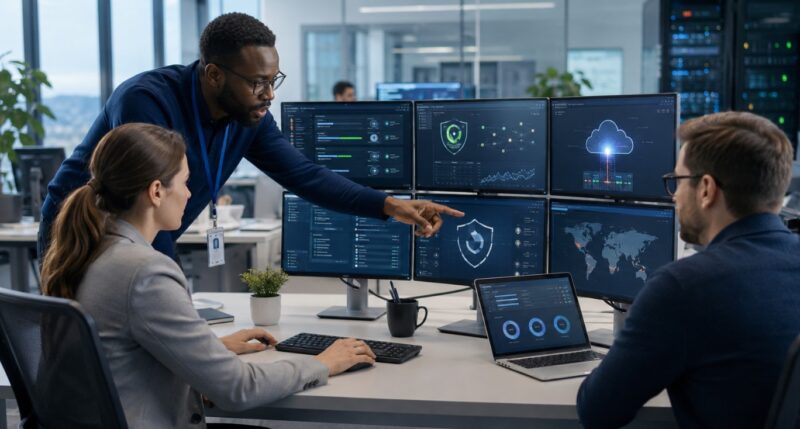
Good IT Support helps businesses by:
- Reducing downtime
- Improving cybersecurity
- Helping employees be more productive
- Keeping software up to date
- Protecting business data
- Helping with compliance
- Supporting business continuity planning
Instead of just fixing problems when they happen many businesses now prioritize preventive maintenance as part of their overall technology strategy.
IT Support and cybersecurity are closely related. Cybersecurity is one of the important parts of modern IT services. Businesses face threats, including phishing attacks, ransomware and unauthorized network access.
IT Support teams help with cybersecurity by:
- Installing security updates
- Managing endpoint protection
- Monitoring activity
- Configuring secure network settings
- Educating employees about security risks
- Supporting backup and recovery procedures
These practices help reduce the likelihood of security incidents and improve a business’s ability to respond if an issue occurs.
Cloud computing has changed how businesses store data and access software. Many companies now use cloud-based applications for communication, collaboration, accounting, customer management and file storage.
As more businesses use cloud technology IT services now include:
- Planning cloud migrations
- Managing user accounts
- Configuring cloud security
- Monitoring performance
- Synchronizing data
- Managing access
These tasks require attention to ensure cloud environments remain secure, reliable and accessible.
Choosing the level of IT Support is important. Every business has technology needs. Factors such as company size, industry regulations, budget and internal expertise influence the level of IT Support needed.
Some businesses do well with an IT team while others partner with a Managed Service Provider for ongoing management. Some companies use a combination of both with in-house staff and external specialists for projects or advanced technical expertise.
The right approach depends on the business’s goals, not a one-size-fits-all model.
The technology landscape is always changing, which affects how businesses manage their IT environments.
Some trends that are shaping the future of IT Support include:
- Using automation for maintenance
- Using intelligence for ticket management
- Expanding remote monitoring capabilities
- Focusing more on cybersecurity resilience
- Using native infrastructure
- Supporting hybrid and remote workforces
These developments allow IT professionals to spend time on routine tasks and more time solving complex technical problems.
Frequently Asked Questions
How quickly should an IT Support provider respond to an issue?
Response times are usually defined in a service level agreement rather than left open. Critical incidents that stop work for the whole company are typically answered within an hour, while lower-priority requests may be scheduled for the same or next business day. Agreeing on these categories in advance prevents disagreements later.
What is the difference between IT Support and IT consulting?
IT Support focuses on keeping existing systems running: monitoring, maintenance, troubleshooting and user assistance. IT consulting is advisory work aimed at planning, such as designing a new network or evaluating which platform a company should adopt. Many providers offer both, but the two are usually contracted separately.
Is remote IT Support as effective as on-site support?
Most issues, including software errors, account problems and configuration changes, are resolved remotely without any loss of quality. On-site visits remain necessary for hardware failures, physical network work and new office setups. A common arrangement combines remote support as the standard with scheduled on-site visits when needed.
Does hiring a Managed Service Provider mean replacing internal IT staff?
Not necessarily. In a co-managed arrangement, internal staff handle daily user requests and company-specific systems, while the provider covers monitoring, security and specialised projects. This model is often chosen by companies that have one or two internal technicians and need broader coverage without expanding the team.
Who owns the company data and system access when working with an external provider?
The client company retains ownership of its data, accounts and licences. Documentation, administrator credentials and configuration records should be clearly assigned to the client in the contract, so that systems remain fully accessible if the company later changes providers.
Conclusion

In conclusion technology plays a role in almost every industry making good IT Support more important than ever. Whether it is provided by a team or a Managed Service Provider, effective IT services help businesses keep their systems secure, reduce downtime and support everyday operations.
As technology continues to evolve businesses that invest in IT Support are better able to adapt to changing demands, protect valuable data and maintain operational continuity. Understanding the role of IT Support helps businesses make decisions about the technology they use every day.